
People don’t always need to click through several search results to find an answer anymore. AI-powered search features like Google AI Overviews can provide that answer directly.
That changes things for websites and content creators. It is no longer just about getting a page to appear in search results. The content also needs to be clear and useful enough for AI systems to understand, process, and potentially use when answering a question.
That’s what Answer Engine Optimization (AEO) is about.
In this post, you’ll learn what AEO is, how it works, how it differs from SEO and GEO, and how to improve your chances of getting cited by AI.
Let’s get started.
What is Answer Engine Optimization?
Answer Engine Optimization (AEO) is the practice of creating and structuring content so answer engines can understand it and use it when generating answers to user questions.
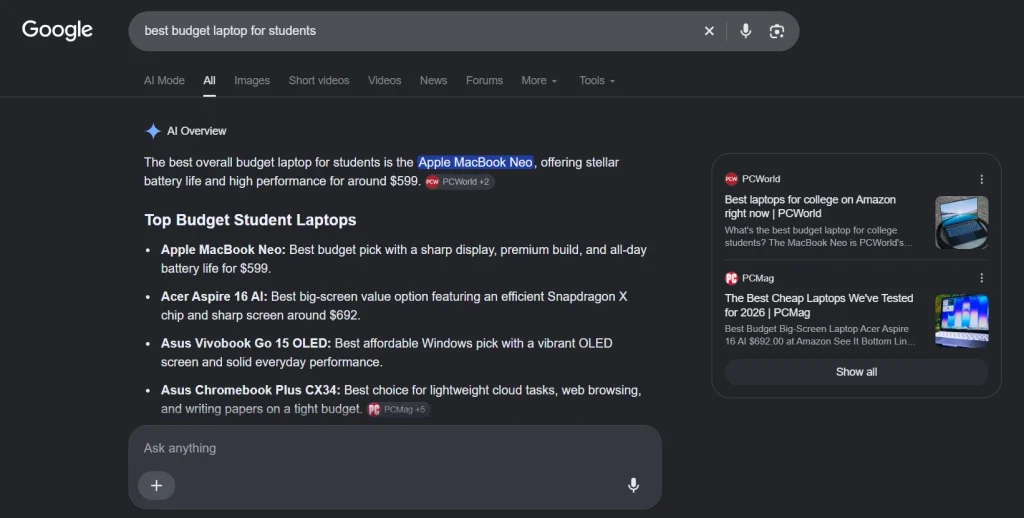
Here, the goal is not a high ranking. The goal is inclusion in the answer itself.
That distinction matters. A page can rank on page one of Google and never appear in an AI-generated answer. At the same time, a page that ranks lower can still be cited if it provides information an answer engine considers useful and relevant.
What counts as an answer engine?
An answer engine is any search or AI system that gives users a direct response instead of simply returning a list of website links.
Google AI Overviews, ChatGPT, Perplexity, Gemini, and Microsoft Copilot are some of the main examples.
They do not all work in exactly the same way. Some generate answers from web search results, while others can combine information from multiple sources before producing a response.
AEO vs. SEO vs. GEO: What’s Actually Different?
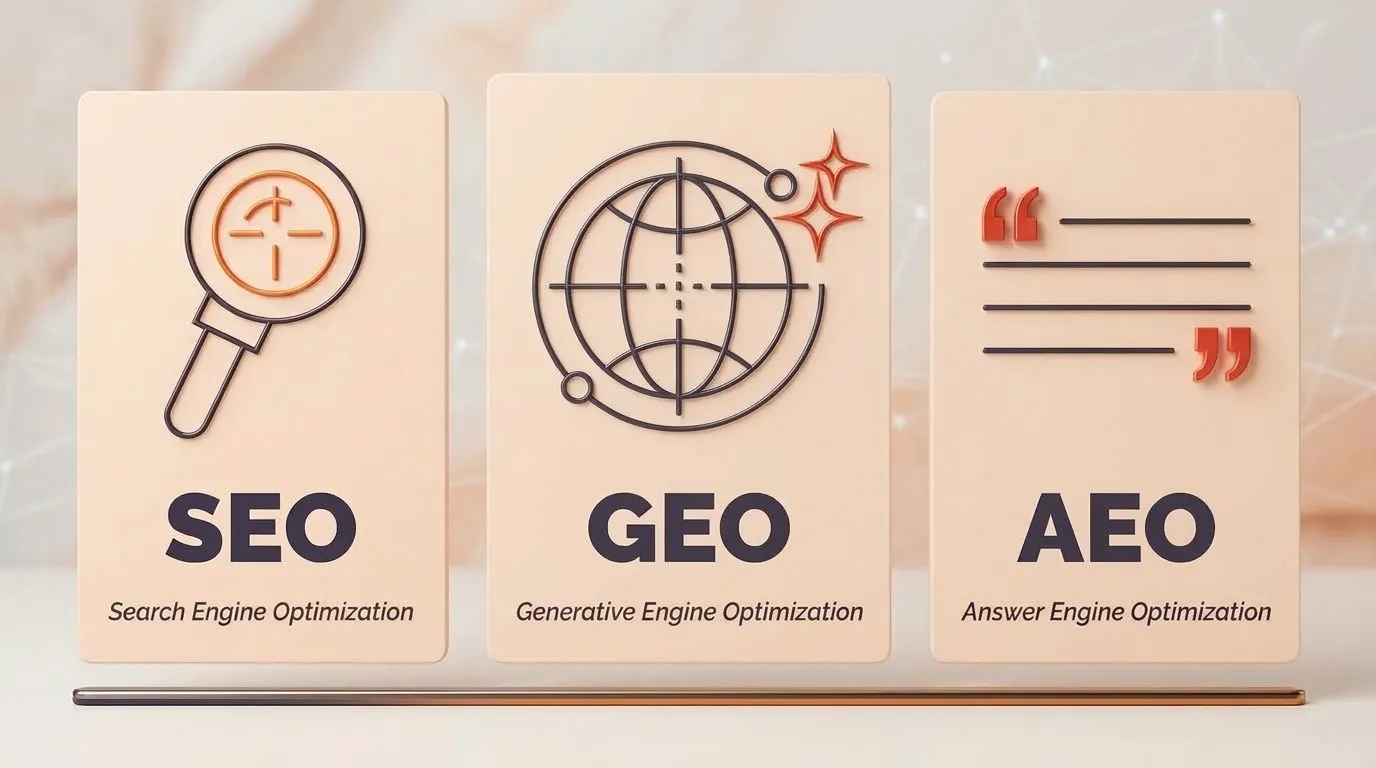
SEO, AEO, and GEO all deal with search visibility, but they focus on different outcomes.
Imagine someone searches for “how often should a small business post on social media?”
- With SEO, the goal is to get a page ranking in the search results. If the page ranks well and the person clicks it, SEO has done its job.
- With AEO, the focus shifts to the answer itself. If an answer engine needs information about posting frequency, it may use a clear explanation from your content when generating its answer.
- With GEO, the focus is broader. The aim is to make your content or brand visible in AI-generated responses. The system might cite your article, mention your brand, or use information from your website in its response.
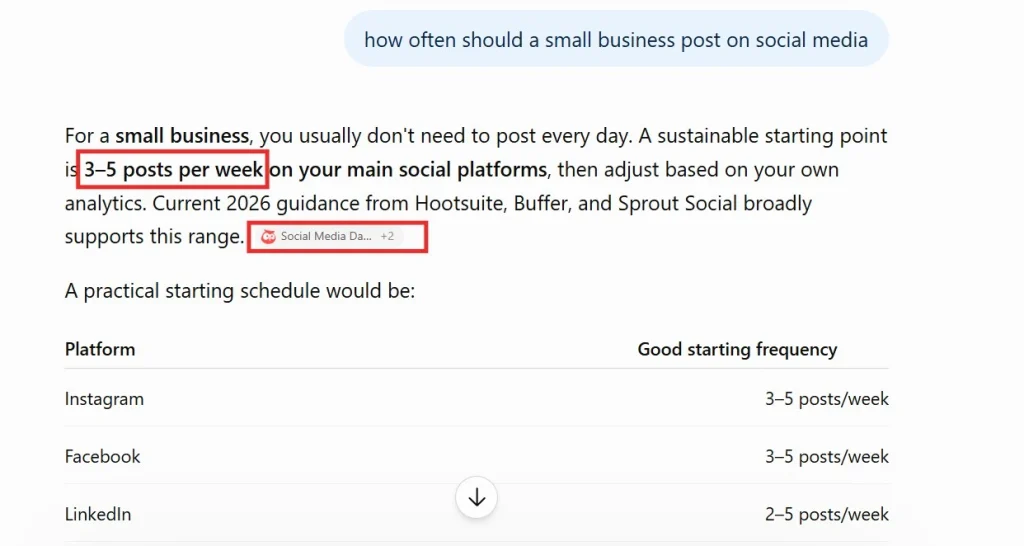
For example, imagine an AI response says:
“Most small businesses can start with three to five social media posts per week.”
If that recommendation comes from information in your article, your content has helped provide the answer. That’s where AEO comes in.
If the response also says:
“According to [Your Brand], three to five posts per week is a good starting point.”
and links to your article, that is AI visibility through a citation or brand mention, which falls under the broader GEO idea.
For a full breakdown of how these three actually compare, see GEO vs AEO vs SEO: A Side-by-Side Comparison for 2026.
How does AEO work?
AEO makes more sense when we look at what happens after someone asks a question.
Imagine someone asks an AI-powered search tool:
“How much does it cost to build a website for a small business?”
The system does not simply look for a page with those exact words. It needs to understand what the person is actually asking, find useful information, and then build an answer from the sources it considers relevant.
1. Understanding what people are asking
First, the system needs to understand the question and the intent behind it.
Someone searching “website cost” could be looking for pricing, examples, or information about different website types. Someone asking “How much does a small business website cost?” has a much clearer intent.
This is why AEO starts with understanding questions, not just adding keywords to a page.
2. Finding relevant information
Once the question is understood, the answer engine needs information it can use.
It may look at relevant pages, documents, or other sources and identify information that helps answer the question.
This is why simply mentioning a keyword throughout an article is not enough. The page needs to contain a useful, clear answer in the first place.
3. Building the answer
The system can then combine information from relevant sources to create a response.
For example, if someone asks “How much water should a person drink each day?”, an answer engine may use information from several reliable sources rather than copying one webpage from beginning to end.
This is an important difference from traditional search. The user may see the answer first instead of a list of pages to read.
4. Citing or mentioning sources
Some AI search experiences show the sources used to support an answer. A website may be cited, mentioned, or linked as a source.
Getting cited is not guaranteed, though. There is no simple AEO formula that tells an answer engine to choose one website over another.
How to Optimize Content for Answer Engines
There is no secret formula for getting content cited by AI. But a few practical things can make content easier for answer engines to understand and use.
- Answer questions directly. Give the answer early instead of making readers dig through a long introduction. If a section asks “How often should a small business post on social media?”, answer that question first, then explain the reasoning.
- Structure content clearly. Use descriptive headings, short paragraphs, lists, and tables where they make sense. Keep each section focused on one question or idea so the information is easy to understand and extract.
- Show real experience. Add something that comes from actual work or research, such as a specific example, original data, or a lesson learned from a project. Generic advice is easy to repeat, but firsthand information gives the content something of its own.
- Back up important claims. Use reliable sources for statistics, research findings, product information, and other factual claims. When possible, link directly to the original source rather than repeating information from another article.
- Keep information up to date. Check statistics, examples, product details, and other information that can change over time. An article that gives outdated information is less useful to both readers and answer engines.
Frequently Asked Questions (FAQs)
No. AEO and SEO work alongside each other. SEO helps content appear in traditional search results, while AEO focuses on making information useful for answer engines.
Not necessarily. Start by reviewing existing pages and look for places where questions could be answered more clearly, sections could be better structured, or outdated information could be updated.
Yes. AEO can help businesses appear when people ask specific questions related to their products, services, or industry. Clear, useful content can give smaller websites opportunities to be included in relevant answers.
There is no fixed timeframe. AI responses can change based on the question, platform, sources available, and other factors. Track a consistent set of queries over time rather than expecting an immediate result.
There is no general advertising option that guarantees a citation in an organic AI answer. Citations are selected by the individual system based on the information and sources it uses.
Not necessarily. Good AEO content still needs to be useful, relevant, accurate, and well structured. The main difference is putting more focus on answering specific questions clearly.
They overlap, but they are not always used to mean the same thing. AEO generally focuses on making information useful for direct answers, while GEO is often used more broadly for improving visibility in generative AI responses.
No. There is no reliable way to guarantee a citation. The best approach is to create useful, well-supported content and monitor how often it appears in relevant AI responses.