
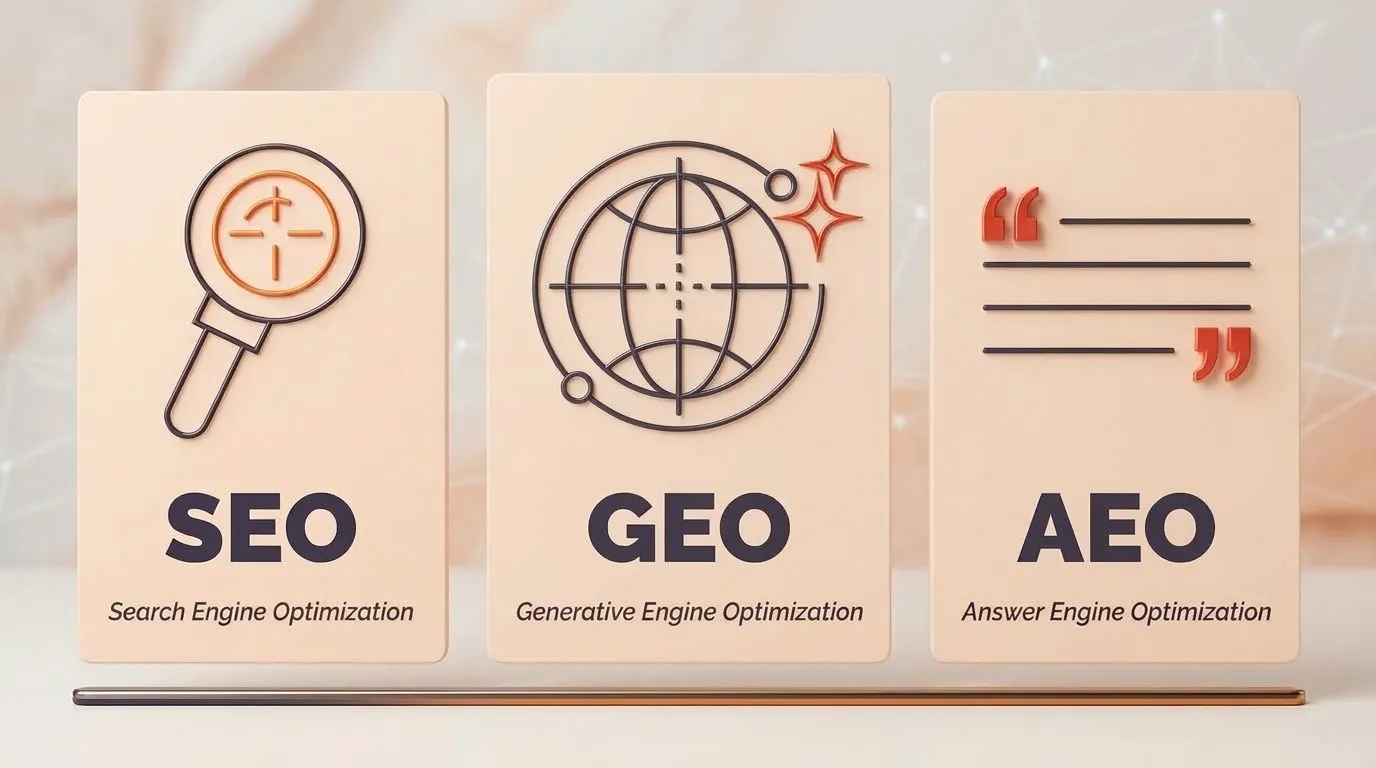
AEO, GEO, and SEO are three ways to optimize content for different search experiences. SEO focuses on visibility in search results; AEO focuses on getting information selected as a direct answer, and GEO focuses on getting content cited or referenced in AI-generated responses.
Search is no longer limited to a list of traditional search results. People can now find information through AI Overviews, conversational AI tools, featured answers, and other search experiences.
This has made AEO and GEO increasingly important topics for content creators and businesses.
However, they do not replace SEO or operate as completely separate systems.
The same article can rank in traditional search results, provide a direct answer to a question, and be cited in an AI-generated response.
In this guide, we’ll compare SEO, AEO, and GEO, explain where they differ and overlap, and show how to optimize content for all three without treating them as separate processes.
SEO vs AEO vs GEO at a Glance
SEO, AEO, and GEO overlap in many ways, but they are not identical. Here’s a quick look at their key differences.
| SEO | AEO | GEO | |
| What does it mean? | Search Engine Optimization | Answer Engine Optimization | Generative Engine Optimization |
| What is the main goal? | Help relevant people find and visit your website through search results | Get your content surfaced as the direct answer to a question | Get your content cited, referenced, or mentioned in AI-generated responses |
| What does the content need? | Relevant, useful, accessible, and trustworthy information | Clear answers, useful structure, and concise explanations | Original information, evidence, clear claims, and strong relevance |
| Where can it appear? | Search results and search features | Featured answers, People Also Ask, voice search, and other answer-focused features | AI Overviews, AI search experiences, and conversational AI platforms |
| How can you measure it? | Rankings, impressions, clicks, traffic, and conversions | Answer-feature visibility and question-based search visibility | AI citations, mentions, referrals, and visibility across tracked queries |
It’s worth noting that these categories aren’t strictly separate. A featured snippet can also be pulled into an AI Overview, and a page that ranks well in traditional search is often more likely to be used as a source in an AI-generated response. Think of this table as a way to understand the main focus of each concept, rather than as a set of fixed, non-overlapping boundaries.
What Is SEO?
SEO focuses on helping your content rank and get discovered in traditional search results. It relies on search engines crawling, indexing, and ranking pages based on relevance, quality, and trust signals. The goal is to be visible enough that the right people find your content when they search.
How Does SEO Work?
Search engines generally go through several stages before showing a page in search results:
- Crawling: Automated bots (called spiders or crawlers) scan the internet by following hyperlinks from page to page to find new and updated content
- Indexing: The search engine analyzes the text, images, and page structure of crawled content and stores valuable pages in a massive database called an index.
- Ranking: When a user types a query, an algorithm sifts through the index to serve the most relevant, high-quality answers on the Search Engine Results Page (SERP).
What Does SEO Focus On?
SEO can involve many parts of a website and its content, including:
- Search intent: matching what people are actually looking for, not just the words they typed
- Helpful content: information that’s genuinely useful, not written just to rank
- On-page optimization: clear titles, headings, meta descriptions, and content structure that help search engines understand the page
- Internal linking: connecting related pages so both users and search engines can discover related pages on your website
- Technical accessibility: Making sure search engines can crawl, index, and access pages properly
- Page experience: Load speed, mobile-friendliness, and overall usability
- Authority and reputation: Backlinks, brand mentions, and other signals that tell search engines your site can be trusted
What Is AEO?
Answer Engine Optimization (AEO) is the practice of structuring and improving content so search engines can pull direct answers out of a page for summary boxes, featured snippets, and Google AI Overviews.
How Does AEO Differ From SEO?
Traditional SEO often focuses on helping a page appear in search results. AEO puts more emphasis on the information itself and how easily it can be extracted, understood, and presented as a direct answer.
The two approaches overlap, but they focus on different aspects of search visibility.
SEO asks: How can I help my page appear for a relevant search?
AEO asks: How can I make the information on my page easy to use as an answer?
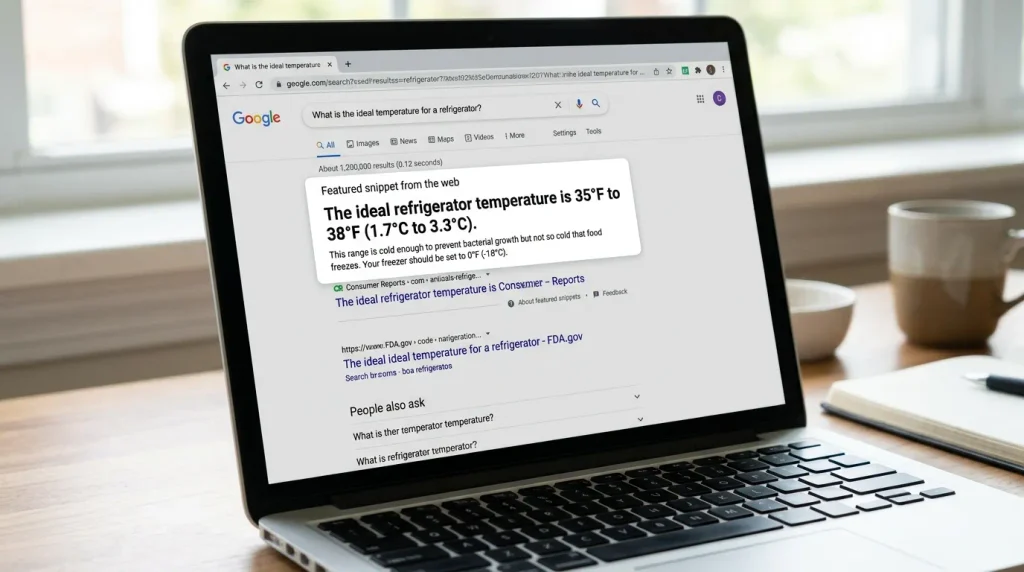
For example, if someone searches “What is the ideal temperature for a refrigerator?”, SEO focuses on helping your page rank for that query. AEO focuses on providing a clear answer that can be shown directly to someone searching for it.
AEO-friendly content generally comes down to answering questions directly, structuring information clearly, and backing up claims with real evidence. For a closer look at how to structure content specifically for AEO, see our guide on Answer Engine Optimization and how to get cited by AI.
What Is GEO?
Generative Engine Optimization (GEO) is the practice of improving content so that it has a better chance of being used, referenced, or cited in AI-generated responses on standalone generative platforms.
For example, if someone asks ChatGPT or Perplexity “What’s the ideal temperature for a refrigerator, and why does it matter for food safety?”, the system may pull from several sources, not just one page, to put together a fuller answer. GEO is about making sure your content is one of the sources worth pulling from.
How Does GEO Differ From AEO?
AEO is largely about being selected or surfaced as a direct answer. GEO is about being used as a source within a broader, synthesized response. A single page can win a featured snippet by giving one clear, direct answer. That same page might also get referenced by a generative AI tool as part of a longer response, alongside two or three other sources.
AEO asks: How can I make this the answer?
GEO asks: How can I make this worth citing or referencing?
What Makes Content Useful to Generative AI Systems
This goes beyond basic keyword optimization:
- Original information: Insights, data, or perspectives that aren’t just repeating what’s already out there
- Firsthand experience: Details that come from actually doing something, not just researching it
- Reliable sources: Backing up claims with credible, verifiable references
- Clear claims: Stating things directly, without unnecessary hedging or ambiguity
- Supporting evidence: Data, examples, or context that back up what you’re saying
- Strong topical relevance: Staying focused and going deep on a subject, rather than covering it thinly
- Consistent entity information: Using the same names, descriptions, and details about your brand or authors across your site and other platforms
- Clear authorship: Making it obvious who wrote the content and why they’re credible on the topic
- Well-structured content: Organized in a way that’s easy for AI systems to parse and reuse
- Updated information: Keeping facts, data, and examples current
What SEO, AEO, and GEO Actually Look Like
To see how this plays out in practice, we ran one real query – ‘What’s the ideal temperature for a refrigerator?’ – across a traditional Google search, Google’s AI Overview, and Perplexity.
Google organic results (SEO)
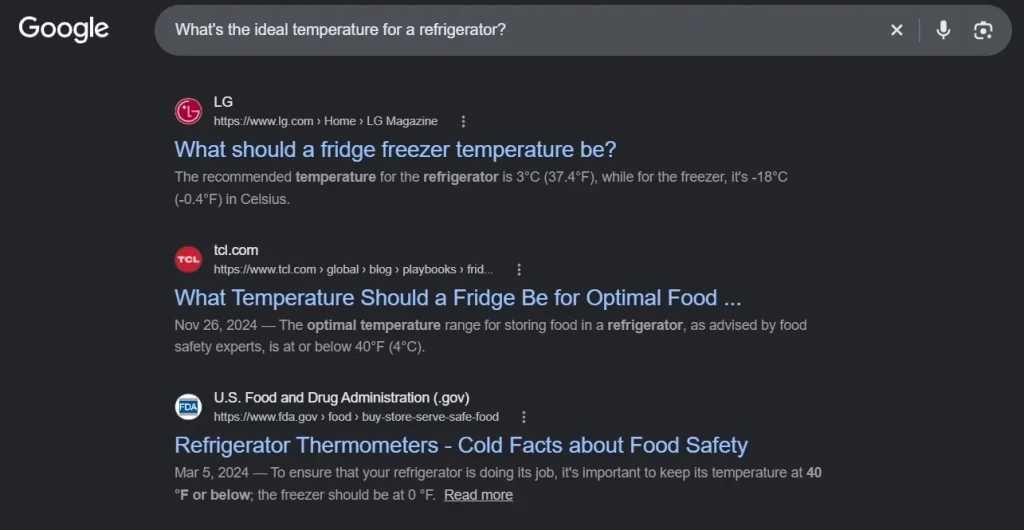
The organic results page showed individual brand and institutional pages ranking separately, each with its own specific answer. LG’s result gave a fridge temperature of around 3°C (37.4°F). TCL’s page, aimed at its own appliances, recommended 40°F. The FDA’s page also ranked, offering a more general food-safety angle rather than a single number. Each page is a standalone destination the user would need to click into individually.
Google AI Overview (GEO)
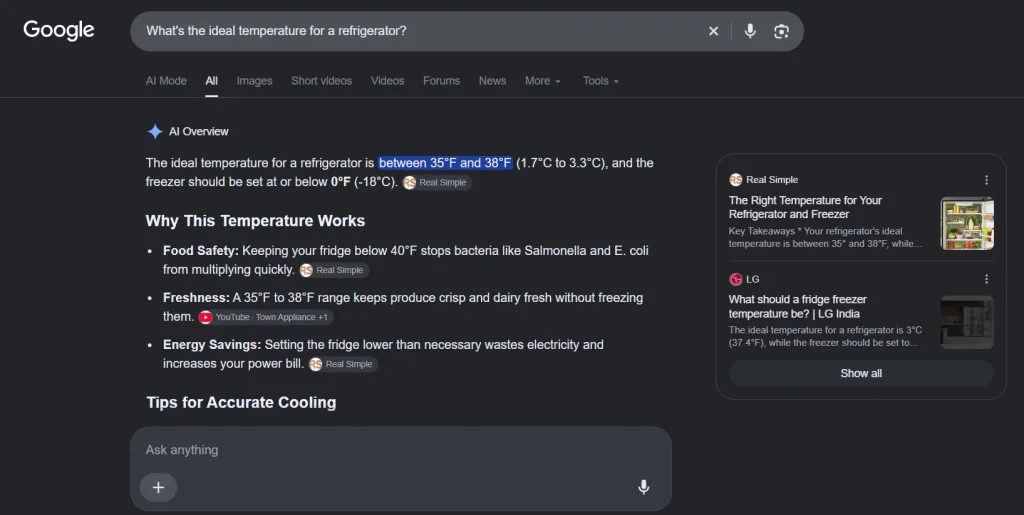
Rather than pointing to one page, the AI Overview pulled together a synthesized answer citing multiple sources, including a visible link alongside other referenced sources. It gave a temperature range (35–38°F) along with a short explanation, effectively combining several separate organic results into one unified response with multiple citations woven throughout.
Perplexity (GEO)
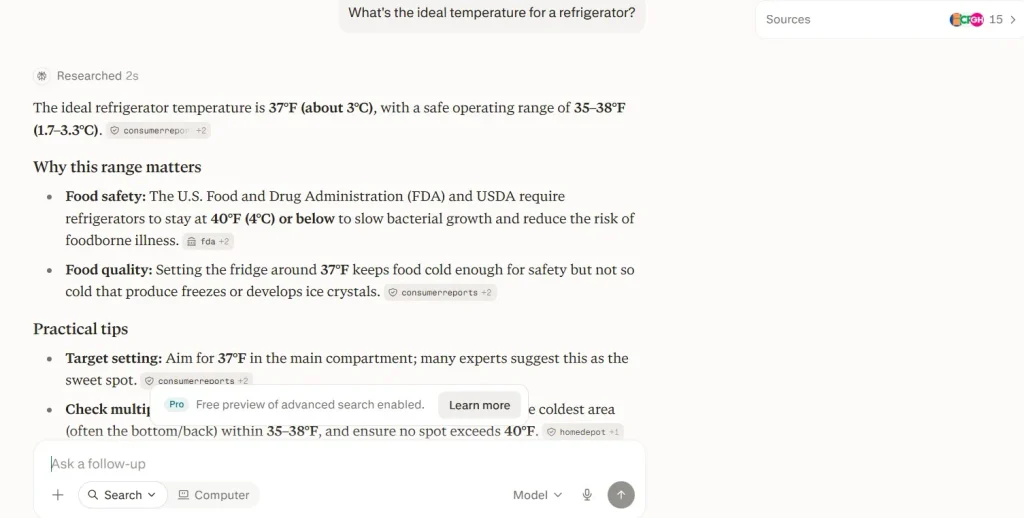
Perplexity’s answer followed a similar synthesis pattern, giving a single-number recommendation (around 37°F/3°C) alongside practical guidance, and citing the FDA inline, with a total of 15 sources referenced.
How SEO, AEO, and GEO Actually Played Out Here
This example highlights the different roles of SEO, AEO, and GEO:
- SEO is about earning visibility in traditional search results. LG, Samsung, and the FDA each appeared as individual results the user could click into.
- AEO focuses on surfacing one clear, direct answer, typically pulled from a single source. This particular query didn’t produce a classic AEO placement, like a featured snippet or “People Also Ask” box; Google went straight to an AI Overview instead.
- GEO is about making your content useful as a source for a generated response. Both the AI Overview and Perplexity combined information from multiple sources into new, synthesized answers, with attribution to some of those sources.
It’s worth noting that AI Overviews don’t always work this way. For simple, factual queries, Google’s AI Overview sometimes pulls from a single source and behaves more like a classic AEO placement, a direct, extracted answer. For more complex queries, like this one, it tends to synthesize from multiple sources, which puts it closer to GEO.
In practice, AI Overviews often sit right at the intersection of the two, and which side they lean toward depends on the query itself.
A quick caveat: this is a snapshot of one query at one point in time. AI Overviews, Perplexity, and other tools change frequently, and the same query could surface different results, sources, or citation behavior in the future.
How SEO, AEO, and GEO Work Together
SEO, AEO, and GEO are better understood as overlapping approaches rather than a progression from “old” search to “new” search. They work more like layers, each one building on what came before.
- SEO lays the foundation. A page generally needs to be crawlable, indexable, and relevant before it has any chance of being used elsewhere.
- AEO builds on that foundation by making information easy to surface as a direct answer.
- GEO takes it a step further, helping your content show up inside AI-generated responses that pull from multiple sources at once.
Google has published guidance stating that optimizing for AI Overviews and AI Mode remains part of SEO rather than a separate discipline, explaining that these features rely on its core Search ranking and quality systems.
In practical terms: a page that isn’t crawled, indexed, and ranked can’t contribute source material to an AI-generated response, no matter how well it’s written for AEO or GEO. That’s why SEO fundamentals still matter, even as more visibility shifts toward answer-focused and AI-generated features.
How to Optimize One Article for SEO, AEO, and GEO
You don’t need three separate optimization processes for SEO, AEO, and GEO. Many of the same content practices can cover all three at once.
1. Start with search intent – SEO + AEO + GEO
Before writing, understand what the reader is actually trying to find out.
Look at the search results, People Also Ask questions, related searches, and the types of pages already appearing for the query. This helps you match the content to the underlying intent rather than simply repeating the target keyword.
2. Answer early – AEO + GEO
Don’t make readers or search systems work through several paragraphs before reaching the main answer.
For questions with a clear answer, provide a concise response near the beginning, then expand on it with supporting details, examples, and context. This makes the information easier for answer-focused and generative systems to identify and use.
3. Build useful depth – SEO + GEO
A short, direct answer is a starting point, not the whole article.
Cover important subtopics, explain relevant concepts, include examples, address common follow-up questions, and provide enough context for the reader to understand the subject. Comprehensive coverage can also give generative systems more useful information to draw from when constructing a response.
4. Add original information – GEO
Firsthand experience, original data, or a perspective that isn’t already sitting on ten other pages gives your content something worth citing.
This could include original research, testing, calculations, comparisons, examples, expert commentary, or analysis of data. Generic, easily repeatable advice is far less likely to stand out to a generative AI system pulling from multiple sources.
5. Cite reliable sources – GEO + SEO
Back up claims and statistics with credible references, such as official documentation, government publications, research papers, company reports, or original datasets.
This builds trust with readers, strengthens your authority signals for search engines, and gives AI systems a reason to treat your content as dependable.
6. Use descriptive headings – SEO + AEO + GEO
Write headings the way people actually ask questions.
Instead of vague headings such as “More Information” or “Things to Know,” use specific headings. This helps search engines understand what each section covers, helps answer engines identify extractable answers, and helps AI systems quickly locate relevant sections when generating a response.
7. Make content easy to scan – SEO + AEO
Use short paragraphs, bullet points, and tables where they genuinely help.
Readers should be able to quickly find the section they need. Clear formatting also makes individual facts, steps, and answers easier for answer engines to extract cleanly.
8. Strengthen internal links – SEO
Link to relevant pages on your own website using descriptive anchor text.
This helps search engines understand how your content connects and signals topical depth across your site.
9. Show who wrote the content – trust and transparency
Make the author identifiable and provide relevant information about their experience or expertise.
An author bio can help readers understand who is responsible for the information they’re reading.
For topics that require specific expertise, clearly showing the author’s qualifications or relevant experience can build trust with readers and reinforce the kind of authority signals that both search engines and AI systems increasingly rely on.
10. Keep information current – SEO + AI search
Update outdated information, replace broken sources, and make meaningful revisions when the subject changes over time.
Outdated content is less useful to readers, and AI systems are more likely to favor recent, accurate information when generating responses.
11. Make sure search engines/AI crawlers can access the page – technical SEO
None of these matters if your content can’t be crawled in the first place.
Check that your site isn’t accidentally blocking relevant crawlers by robots.txt or other directives, and keep technical basics like page speed and mobile usability in good shape.
Do You Need to Choose Between SEO, AEO, and GEO?
No.
Instead of asking “should I focus on SEO, AEO, or GEO,” a more useful question is: how can I create content that’s genuinely useful to people, and accessible across the different ways they now search?
Most well-built content doesn’t need three separate optimization processes. As the checklist above shows, a lot of the same practices, like clear structure, original information, credible sources, and technical accessibility, serve all three at once. Treating them as one connected effort, rather than three competing priorities, is usually the more realistic approach.
Common Misconceptions About SEO, AEO, and GEO
SEO, AEO, and GEO are often discussed as if they are three completely separate systems. In practice, they overlap considerably, and many claims about optimizing for AI search are more complicated than they first appear.
AEO replaces SEO
No. AEO depends on SEO fundamentals working in the background; a page still generally needs to be crawled, indexed, and considered relevant before it has any chance of being surfaced as a direct answer.
GEO is completely separate from SEO
No. There’s substantial overlap. Google has said that optimizing for its AI-generated search features is still part of SEO, not a separate discipline, since these features rely on the same core ranking and quality systems as regular search.
Adding FAQ schema guarantees AI citations
No. Schema markup can help systems understand your content more clearly, but it doesn’t guarantee inclusion in an AI Overview, a chatbot response, or any other AI-generated answer. There’s no markup that forces a citation.
You need to write special content just for AI
Not really. The qualities that make content genuinely useful – clear answers, original insight, credible sourcing – are the same qualities that make it more likely to be surfaced or cited by AI systems. There’s no separate “AI content” formula.
AI always prefers short answers
Not universally. Leading with a direct, concise answer helps, but that doesn’t mean the rest of the content should be thin. AI systems still favor pages with enough depth and context to support the answer, not just a bare one-liner.
More keywords mean better AI visibility
No. Keyword stuffing hasn’t really worked for regular SEO in years either. AI systems are working to understand meaning and context, not counting how many times a phrase appears.
There’s a formula that guarantees citations
No. Despite plenty of confident claims online, no technique reliably guarantees a citation from any AI system. You can improve the quality and accessibility of your content, but no specific word count, heading structure, schema type, or optimization technique guarantees that your page will be cited.
Frequently Asked Questions
No. AEO focuses on making a specific piece of information easy to surface as a direct, single-source answer. GEO focuses on making content useful as a source within a broader, AI-generated response that may draw on multiple sources at once.
They overlap significantly, but they’re not quite the same. AEO builds on SEO fundamentals, like crawlability, relevance, and authority, but adds an extra layer focused specifically on making information easy to extract and present as an answer.
No. GEO depends on SEO working well in the background. Content still generally needs to be crawled, indexed, and considered credible before it has a real chance of being pulled into an AI-generated response.
Yes, and that’s usually the most realistic approach. Clear structure, direct answers, original information, and credible sourcing tend to support all three at once, rather than requiring three separate versions of the same content.
It can help. Schema markup makes it easier for search engines and AI systems to understand what a page is about, but it doesn’t guarantee a featured snippet, an AI Overview appearance, or a citation on its own.
Often, yes. Strong organic rankings can make a page more likely to be considered by AI Overviews and other generative features, since many of these systems still rely on core search ranking and quality signals.
It depends on the goal, but SEO is usually the best starting point, since AEO and GEO both depend on a page being found and trusted in the first place. From there, small sites can compete just as well on AEO and GEO as larger ones.
Not strictly necessary, but it helps a lot. AI Overviews, for instance, often pull from pages that already rank well organically, since they rely on the same core ranking and retrieval systems as regular search. Other platforms, like ChatGPT or Perplexity, don’t depend on Google rankings directly, but they still favor content that shows the same signals search engines reward: relevance, clarity, and credibility.